Monday, August 26, 2013
Decrease in Go Level = Emotional Maturity?
My Go level has been decreasing recently.
But somebody told me that it is good that it is dropping.
Because it means that I'm growing emotionally.
Hmmmmm.
Really?
But how come I know of people who play better after they found a partner?
Can't my partner also become a motivation for me to play better?
If all the Go Players' level drop when they grow emotionally.
Does that mean those top pros shouldn't grow?
They should remain childish in order to play Go well?
In a way it's true, because now he recent trend is that the younger the player the stronger he is.
And when a player grows older his Go skills tend to drop also.
Furthermore, Go is a game where you cannot get too emotional.
If you get too emotional, you will tend to lose focus and lose the game.
However, I believe that understanding Go alone is not the only way to improve in Go.
If it's really true that I'm growing emotionally, it's good.
But I don't want my Go level to drop either.
Maybe in the future I wouldn't really care anymore.
But for now.
I still want to be strong.

Wednesday, August 7, 2013
What pros do in last 10 seconds of byoyomi
1s: Think
2s: Think
3s: Think
4s: Think
5s: Think
6s: Think
7s: Think
8s: Think
9s: Puts hand to stone. Continues to think
9.2s: Grabs stone. Continues to think
9.5s: Checking whether the reading is correct
9.7s: One last thinking
9.8s: Plays stone on the board
Thursday, July 18, 2013
What's the most important factor to play Go well?
What's the most important factor to play Go well?
Somebody asked me this question.
Stunned with the sudden question, I didn't really know how to answer, so I told her there are many.
And I gave a few examples.
But it is really true that there is no such thing as "most important" when it comes to playing Go.
You need a combination of many different factors in order to play it well.
In my opinion, here are some of them:
1. Reading Ahead
In its very essence, Go is all about reading.
It's a competition to see who can read faster and deeper.
To see who can find out the best move in different situations.
It is very hard to improve in Go if you do not make the effort to read ahead before playing them out.
2. Organising Thoughts
Just reading out the variations alone is not enough.
After reading each variation, you need to organise them properly.
You need to judge which one is better, or which one has a higher chance of winning.
You may have thousands of ideas when playing, so it is important to cut down to the correct ones which are more likely to gain you an advantage.
What if the opponent doesn't respond the way you want?
That's something you need to consider as well.
3. Memory
Go is probably a game which requires more memory work than other board games.
No matter how strong your reading is, it is impossible to read out every single variation on the board.
There are some things which are harder to find out through reading also.
Either you know, or you don't know.
Hence, it is important to spend some effort to remember certain ways of playing in certain situations.
These are commonly known as "Joseki".
These are also the what the great players of the past and modern have found out through research.
Learning them is akin to reading through research papers.
You can only gain, not lose.
Of course, common shapes and tesuji are important as well.
4. Creativity
Just like many subjects, other than memorising those important stuffs, you need to have your own idea as well.
This is not really compulsory.
But if you want to make the game more fun, you should have your own ideas and try them out.
There are also many hidden good moves that are out of common knowledge.
So a little bit of creativity will be useful in finding them.
5. Instinct
This is not really something that can be trained.
Rather, it can only be built with many years of practice.
Some people have better instincts than others.
Just continue playing and doing problems, and your instincts will come naturally.
6. Willingness to Learn
Just like many other things, it's very difficult to improve when you are not willing to learn.
Always have a learning attitude, and never be proud just because you attained a certain level.
Review every game with your opponent, and listen to what stronger players say.
Of course you can have your own ideas, but you won't lose out by listening to other people's ideas.
7. Patience
Go is a game which requires a tremendous amount of patience.
The size of the board is 19x19, and there are 361 coordinates on the board.
Of course you don't have to fill up the whole board, but it's still a very long process from the beginning to the end of the game.
If you rush the game, then the chance of you making mistakes are much higher.
This is especially the case when you are losing the game.
It is important to always be calm and patient throughout the game and wait for chances.
You never know when it will come.
And trust me, it's not easy to do that for the whole game, hence you have to start by doing it consciously.
8. Stamina
After reading all the above points, I'm sure you know why Go requires a lot of stamina.
A typical game of Go usually lasts from 1 hour to 3 hours for amateurs.
For professionals, they can last longer, from 5 hours to even 2 days.
And during all that time, you need to constantly be reading out variations, organising them, and judging whether they are good or bad.
The moment you loosen your brain is the moment you lose.
That's why, if you want to play Go well, get a strong body and build up your stamina.
You are definitely going to need a lot.
Thursday, June 27, 2013
Off to Incheon, Korea
Flying to Incheon, South Korea for the 4th Asian Indoor & Martial Arts Games.
There are pros joining this tournament, unlike the World Mind Sports Games last year.
So it will be harder for us to get into the top 4.
Nevertheless, we will still try our best!
Singapore Team, fighting!
Saturday, June 15, 2013

Friday, May 31, 2013
Tsumego #075
 |
| http://bit.ly/116bwH6 |
#075
★★★
Black to kill.
Some problems are really funny when you see the solution.
They just seem to go against common sense.
Thursday, May 30, 2013
Tsumego #074
 |
| http://bit.ly/19ovG6K |
#074
★★
Black to live.
I just realised I still have not posted this famous problem.
It may be difficult for those who see this for the first time.
This problem also illustrates the wonders of Go. :)
Tuesday, May 14, 2013

Friday, April 26, 2013
Dan-phobia
Every time I hear somebody say something like "I will never be a dan player" or "I will never get stronger", I feel like giving that person a huge slap on the face.
Unless you have a mental illness, I don't think there's are any reasons why you cannot be a dan.
The speed may vary from people to people. I've some friends who can get from nothing to 1-2 dan in 2 years. Some even faster.
Everybody will definitely get there eventually, if you have two things.
1. Belief in yourself
2. Interest aka passion
If you have these two things there, there's no way you are not getting there.
Getting to the dan level is not like getting into the top university in the world or getting full score for SAT.
The requirement is not very high.
All you need is to know some basic josekis and shapes and be able to perform some basic reading and judgement.
That's all.
If you are still struggling at the kyu level.
That means you are either lacking one or more of the two things I mentioned above.
Or you are learning it the wrong way.
In which case I would suggest you look for a proper teacher.
Otherwise everything will be alright.
Believe in yourself!
Go is not so difficult.
And once you get to the dan level, Go will be much more enjoyable.
Unless you have a mental illness, I don't think there's are any reasons why you cannot be a dan.
The speed may vary from people to people. I've some friends who can get from nothing to 1-2 dan in 2 years. Some even faster.
Everybody will definitely get there eventually, if you have two things.
1. Belief in yourself
2. Interest aka passion
If you have these two things there, there's no way you are not getting there.
Getting to the dan level is not like getting into the top university in the world or getting full score for SAT.
The requirement is not very high.
All you need is to know some basic josekis and shapes and be able to perform some basic reading and judgement.
That's all.
If you are still struggling at the kyu level.
That means you are either lacking one or more of the two things I mentioned above.
Or you are learning it the wrong way.
In which case I would suggest you look for a proper teacher.
Otherwise everything will be alright.
Believe in yourself!
Go is not so difficult.
And once you get to the dan level, Go will be much more enjoyable.
Wednesday, April 24, 2013
End of Crazy Stone Era

In the 3rd game of the GS Caltex Cup held on Monday, Kim Jisuk won Lee Sedol by resign.
And hence he claimed the title by winning the legendary Lee Sedol 3-0.
Nobody could stop Dynamite aka Crown Prince Kim Jisuk from claiming the world champion.
Even the Korea No. 1 Crazy Stone aka Lee Sedol.
This is actually the first time Lee Sedol to 0-3 to someone in a 5 game match.
However, he lost 0-2 to Park Junghuan just recently, so people were speculating that he would lose to Kim Jisuk in this championship.
We just didn't expect it to be a clean 3-0 for Kim Jisuk.
The third game was also very complicated, and in fact out of the 3 games, it was the game in which Lee Sedol had the most chance.
Let's take a look at how the 3rd game was like:
(Skip the game and go to conclusion)

The game until here was quite "normal". No new josekis, no new variations this time. I wonder if this is because in the first two games Lee Sedol's new josekis were not very successful so he didn't dare to use them in this game, or he thinks that he has a higher chance of winning this way. Whichever it is, when white played 28, this game was going in a very simple direction. Black attacks, white defends. Black needs to gain profit through attacking, while white needs to live the group while not letting black getting too much profit at the same time.

Black had a few choices but in the real game black chose to go for the cap at 29. White 30 is not really a common move in this case. Usually white would go for moves like A so as to make eye shape while not making the group too heavy at the same time. Black 31 is a very severe move, and is also a must to prevent while from making living on top. White 34 was what Lee Sedol was aiming for. He thinks that those few black stones there are not strong enough. Instead of defending, he counter-attacks black's stones instead. A very Lee Sedol way of thinking.

Black 35 and 37 is a common tesuji. Up to 40 black strengthend itself in sente, but paid the price of losing the top left territory. Black 41 could also have chosen to play at A, but it would become a ko and maybe Kim Jisuk didn't have the confidence to fight the ko. Black 41 is also a severe move and now white needs to run out.

White 44 is the only way out for white. White exchanged 46 and 48 first to emphasize that black also has weakness. However black continued to play strongly at 45 and 51, and Lee Sedol thought for very long here. White 52 is a good move, but black 57 was also very painful for white.
 |
Playing directly at 52 is also possible, but Lee Sedol probably didn't feel good about the cutting aji at 53. |
 |
| If white plays at 58 this way then when black cuts at 59 white needs to play another move at A to defend. |
 |
| 72 = A |
 |
| 82 = 88, 85 = A |
White 86, Black 89 are all very good ko threats. White 90 is actually a very ambiguous place.
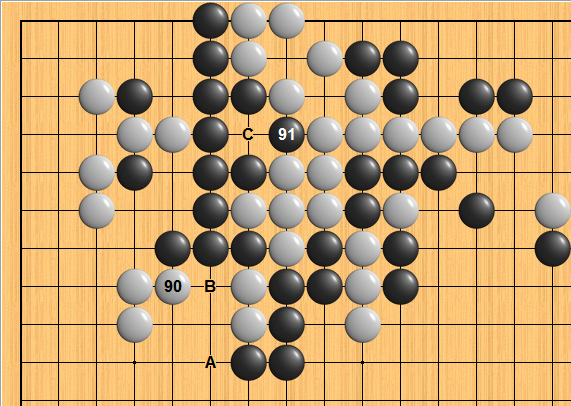 |
| White 90 could also have chosen to play here. This would also reduce Black's liberty by one. When takes at 91, if white continues to fill black's liberties at B, black would connect at C and white loses by 1 liberty. But white can continue to fight the ko and black also would not dare to use the ko threat at A because it would further decrease black's liberties. Maybe playing here would have been better. |
 |
| 91, 97, 103, 109 = 114 94, 100, 106 = 112 |
From the actual game, it can be seen that Lee Sedol didn't have the intention to go for a capturing race at all. He was bent on winning the ko.
The long ko fight finally ended at 114. Even though white had a lot of ko threats in the centre, black also had a lot on top left corner. When black played at 95, white wasn't happy with the exchange where black live in the corner and white live on top, so white continued to fight the ko, ending up in blacking having more ko threats. When black played at 113, white could not answer it anymore.
 |
| If white answers at 114, black would have many more ko threats around the A area, and even B is also a ko threat. It would be impossible for white to win this ko. |

White plays 116 and starts another fight in the centre. From black 117 to white 124 they look like amateur moves and a bit funny. But in actual fact both sides didn't have much of a choice here. Black needed to get sente to play the big move at 125, but the price was the huge white wall in the centre plus the moyo in the bottom left. At this moment the commentator said: "If the whole bottom left belongs to white, this game is already over."
 |
| Because the top left is still a ko, normally black should play a move there to get rid of the ko. However white 126 is a super big move, and it is also most likely sente because white can take the stone at A to threaten the whole black group next. So black had no choice but to play at 126 and fight the ko on the top left. |
 |
| 131 = 135 132 = A |
 |
| If white answers at 134, after black wins the ko black can play the endgame move at A, so white will lose more territory this way. No matter how exciting the game is, always remember to protect your territory, because ultimately that's what will decide the game. |
 |
| 144 = 149 |
Black takes the ko and makes the top left group live, while white runs out the stones by playing at 138. White is not only trying to make the stones but he is also trying to attack the whole group of black stones in the centre. Remember white still has a huge moyo on the bottom left. If white manages to successfully live on the right side and play another move on the left side, it would be game over for black. Hence at this point the game looked better for white. However this whole white group was actually more dangerous than expected, especially after black's strong move at 161.
 |
| The reason white played at A instead of here in the actual game is to prevent black from making an eye in sente like this. With an eye it would be easier for black to fight. Also, in this diagram white also loses its eyes. With a stone at A, at least white still has half an eye at 158, plus white can destroy black's eye in sente like in actual game. |

White 162 is a tesuji. Black played 165 to detroy white's eye, and black had to defend at 167 because black has a cut at A. White 168 is a good move. Until 173, now it became a huge fight that involves the right black group and the top right white group as well.
 |
| 179 = 184 |
 |
| White could actually live by playing this way. But probably he was not happy with this result because the top right died and black gets sente to play on the bottom left white moyo. |
 |
| If black tries to kill by playing at 179, white will connect the ko at 180. Even though black can kill the top right white stones, white gets an eye in sente at 186 and lives at 192. |
 |
| If black 183 plays here, white will connect the ko at 184. This time white will be able to live the whole group in sente, and plays another move to defend the bottom left moyo. Just like the commentator said, the game is practically over if the whole bottom left belongs to white. So this is a no no for black. |
 |
| 185 = 191 188 = A 189 = B |
 |
| 197, 201 = A 200 = 202 White 192 cannot connect here, because black would also connect the ko and the right side would end up in a seki, which also means that the whole white group is dead. Even though white still gets sente, dying a whole group is never a glorious thing. |

At this point the game was definitely better for white. White just needs to gain profit through attacking this group.
White 196 was probably not a very good move. Black 197 is a common tesuji. And black 205, 207 cut was a very strong move. The centre black stones are dead, but because black still has 4 liberties black still can make use of them. Up to 209, black is almost alive. But Lee Sedol still doesn't give in. He goes for the kill at 210.
 |
| White could have chosen to let black live by playing this way. Now black has around 100 points on the board, while white has around 65 excluding the bottom moyo. This means that White just needs 30 points in the bottom moyo in order to win, which doesn't seem very difficult. So why didn't Lee Sedol choose this? 1 word: Kisei. "If I could win by killing the group, why should I let it live?" |
 |
| 216, 222, 228 = 234 217 = A 219, 225, 231 = B 226 = C 232 = D |
 |
| White should have answered at 236. Even if black plays at B later, white can still play at C and nothing will happen. Most importantly, because white didn't play at A, white's left side group has one more liberty, hence the ko is less of a burden for white. |

Probably Lee Sedol already saw this exchange coming when he played at 236, just that he couldn't tell whether it's good or bad. It's impossible to read out all the variations and judge them when you are in the last byo-yomi. The fact is, after this exchange, black is leading by so much it's hard for black to lose now. This is because white's left side stones are all dead, but black could still play at 243 to make white play moves in his own territory to eat the black stones. that's a huge difference. The situation is quite desperate for white after this exchange.

Black gave in a little bit on the bottom, but black's lead still has not changed. White needs to do something on the bottom, so white played at 266. Black played at 267 to exploit white's aji. And white a super strong move at 268. This was white's last attempt to win the game.
 |
| 270 = C If black answers at 269, white will play this way and now there are two cuts at A and B. Things will get complicated for black. |

Black 269 was a good move. Even though white gets territory on the bottom, black also gains the corner and the game would still be good for black.
After that white was desperately trying to create trouble by making use of the dead stones on the left, but black answered everything correctly and nothing serious happened. White 290 was really the last attempt, and black also didn't hesitate playing the strongest move at 291.
 |
| Note that black cannot connect here. Due to the exchanges on the left side white can play at 292 to eat the 3 black stones. Now A and B is miai for white, and white succeeded in turning the game around. |

Black 295 is a good move to make use of the aji in the corner. When black played at 297 white has no choice but to play at 298 to prevent black from living. When black played at 303, white resigned.
 |
| 308 = A If white continues, black would connect at 305, and even though there's damezumari, black would still win by 1 liberty. |

Is this the end of Crazy Stone Era? Most likely, yes. He is still one the strongest, but sadly to say probably the time for him to shine is over. Just like how he ended the Stone Buddha Era.
This actually brings another problem. There is news that Lee Sedol will be having Ten Match Series with Gu Li soon this year. After his defeat in the recent two championships, people may start to question, is Lee Sedol still the world No. 1? Would the event still be worth organising?
On the other hand, Kim Jisuk is definitely happy with his new found champion. In the interview he said that the all 3 games were very difficult and he only could win because of luck. He said maybe he played better because Lee Sedol had always been a senior he admired and hence he could play the game with a more relaxed mind. No matter what the reason is, we all witnessed Kim Jisuk's strong fighting skills that are no weaker than Lee Sedol's. Lee Sedol had almost no chance in the first 2 games, and even in the 3rd game Kim Jisuk managed to turn back the game under unfavourable conditions.
I will of course still be looking forward to Lee Sedol's games. But from now on, Kim Jisuk will be another star worth looking forward to.
Kim Jisuk's Interview:
http://www.cyberoro.com/news/news_view.oro?div_no=A1&num=517837&pageNo=1&cmt_n=0
Full Kifu:
Black: Kim Jisuk 9p
White: Lee Sedol 9p
Black won by resign
(;EV[µ⁄18ΩÏ∫´π˙GSº”µ¬ ø±≠戻¸ŒÂ∑¨∆µ⁄»˝æ÷]DT[2013-04-22]PC[]SZ[19]KM[6.5]US[∆ •µ¿≥°]SO[http://weiqi.tom.com]C[http://weiqi.tom.com
∆ •µ¿≥°-->æ´≤ ±æ÷
18:00Ω¯––,√ø∑Ω10∑÷÷”,3¥Œ40√Î∂¡√Î.π⁄æ¸7000ÕÚ,—«æ¸1500ÕÚ∫´‘™]RE[B+R]PB[Ω÷æŒ˝]BR[∞À∂Œ]PW[¿Ó ¿ Ø]WR[æ≈∂Œ];B[pd];W[dd];B[qp];W[dq];B[oq];W[qf];B[nc];W[rd];B[fc];W[cf]
;B[qh];W[qc];B[qe];W[re];B[pf];W[pg];B[qg];W[rf];B[og];W[jp]
;B[pj];W[co];B[fe];W[di];B[eg];W[dh];B[hi];W[jd];B[jf];W[hc]
;B[kc];W[jc];B[kb]
;W[hf]LB[jf:29][hc:30][jc:32][kc:31][kb:33]L[mc]TR[fc][fe][eg][hi];B[de];W[ce];B[dc];W[ed];B[fd];W[cc]
;B[gg]LB[de:35][ce:36][dc:37][cc:40][ed:38][fd:39]L[he];W[hg];B[hh];W[jg];B[kg];W[gf];B[ff];W[gh];B[fg];W[jh];B[kh]
(;W[kf];B[ke];W[ji];B[je];W[ie]
;B[hd]LB[gf:46][ff:47][fg:49][hg:42][gh:48][hh:43][jg:44][kg:45][jh:50]
[kh:51][ji:54][kf:52][ke:53][je:55][ie:56]
(;W[id];B[ig];W[if];B[ih];W[gb];B[fb];W[ib];B[jb];W[kd];B[le]
;W[ld];B[mc];W[md]
;B[mf]LB[id:58][ig:59][if:60][ih:61][gb:62][fb:63][ib:64][jb:65][kd:66]
[le:67][ld:68][mc:69][md:70];W[gd];B[ge];W[he];B[gc];W[ha];B[hd];W[nd];B[pc]
;W[gi]LB[ge:73][he:74][gc:75][ha:76][hd:77][nd:78][pc:79]L[gd];B[hj];W[gd];B[fa];W[ga];B[hd];W[of];B[pe];W[gd];B[gj]
(;W[fi]LB[hj:81][gd:88][fa:83][ga:84][of:86][pe:87][gj:89]L[hd];B[hd];W[ng];B[oe];W[gd];B[cb];W[ec];B[hd];W[nf];B[ne];W[gd]
;B[bc];W[db];B[hd];W[ob];B[oc];W[gd];B[bd];W[bb];B[hd];W[me]
;B[lf];W[gd];B[cd]
(;W[hd]LB[gd:112][cb:95][nf:98][ne:99][ec:96][bc:101][db:102][ob:104]
[oc:105][ng:92][oe:93][bd:107][bb:108][me:110][lf:111][cd:113];B[dc];W[mg];B[ki];W[jj];B[kj];W[jk];B[kk];W[jl];B[kl];W[jm]
(;B[pb]LB[dc:115][mg:116][ki:117][jj:118][kj:119][jk:120][kk:121][jl:122]
[kl:123][jm:124];W[cc];B[eb];W[ca];B[ee];W[dc];B[da];W[ea];B[cg]
(;W[bg];B[da]
;W[oh]LB[cg:133][bg:134][da:135][cc:126][ca:128][eb:127][ee:129][dc:130]L[ea];B[cb];W[oj];B[ok];W[nk];B[oi];W[nj];B[ni];W[pi];B[qi];W[mi]
;B[ph];W[nh];B[pi];W[ml];B[lm];W[ol];B[pk]
(;W[mj];B[mn];W[lg];B[kf];W[nn];B[no];W[on]
;B[pm]LB[cb:137][oj:138][ok:139][nk:140][oi:141][nj:142][ni:143][pi:149]
[ph:147][qi:145][mi:146][nh:148][ml:150][lm:151][ol:152][pk:153]
[mj:154][mn:155][lg:156][kf:157][nn:158][no:159][on:160];W[qm];B[pl];W[pn];B[om];W[nm];B[pp];W[rl];B[ro];W[rn];B[rj]
;W[rk]
;B[rb]LB[pn:164][pm:161][qm:162][pl:163][om:165][nm:166][pp:167][rl:168]
[ro:169][rn:170][rj:171][rk:172]L[mo];W[rg];B[rh];W[si];B[sh]
(;W[qk];B[og];W[qo];B[rp];W[pg]
(;B[po]
;W[og]LB[rg:174][rh:175][si:176][sh:177][qk:178][qo:180][rp:181][po:183]
[pg:182];B[qn];W[nl];B[sn];W[qo];B[mh];W[lh];B[qn]
(;W[km];B[rm];W[ll]
;B[dk]L[qo][mh]LB[qn:191][nl:186][sn:187][lh:190][km:192][rm:193][ll:194];W[fk];B[cn];W[bn];B[bm];W[dn];B[cm];W[bo];B[bi];W[bh];B[fj]
;W[ej];B[ek];W[fl];B[bk]
(;W[ci]LB[dk:195][fk:196][cn:197][bn:198][bm:199][dn:200][cm:201][bo:202]
[bi:203][bh:204][fj:205][ej:206][ek:207][fl:208][bk:209];B[en];W[em];B[cj];W[ai];B[aj];W[bj];B[ei];W[eh];B[bi];W[qb]
;B[qa];W[bj];B[do];W[dm];B[bi];W[ra];B[sa];W[bj];B[fm];W[el]
;B[bi];W[pa];B[oa];W[bj];B[eo]
(;W[dj]L[ei][bi][ra][pa]LB[en:211][em:212][cj:213][ai:214][aj:215][bj:234][eh:218][qb:220]
[qa:221][do:223][dm:224][sa:227][fm:229][el:230][oa:233][eo:235];B[bi];W[sm];B[ah];W[rn];B[gm];W[so]
;B[rc]LB[dj:236][bi:237][sm:238][ah:239][rn:240][gm:241][so:242];W[qj];B[qd];W[ql];B[fp];W[dp];B[fr];W[mp];B[mr];W[lr];B[sd]
;W[sg];B[se];W[ri];B[mq];W[lq];B[ja];W[ia];B[mo];W[np];B[oo]
;W[ms];B[or];W[hr]
;B[bq]LB[hr:266];W[fq]LB[hr:266][bq:267]
(;B[cp];W[dg];B[fh];W[be];B[af];W[ag];B[ae];W[ai];B[bj];W[ep]
;B[fo];W[am];B[cl];W[gp];B[gq];W[eq];B[go];W[dl];B[ck];W[al]
;B[gl];W[cq]
(;B[gr]LB[cp:269][dg:270][fh:271][be:272][af:273][ag:274][ae:275][ai:276]
[bj:277][ep:278][fo:279][am:280][cl:281][gp:282][gq:283][eq:284]
[go:285][dl:286][ck:287][al:288][gl:289][cq:290];W[hp];B[hq];W[iq];B[cr];W[bp];B[er];W[dr];B[ds];W[cp];B[ir]
;W[hs]
;B[es]C[Ω÷æŒ˝¡„∑‚¿Ó ¿ Ø∂·µ√∏ˆ»Àµ⁄2π⁄]LB[gr:291][hp:292][hq:293][iq:294][cr:295][bp:296][er:297][dr:298]
[ds:299][cp:300][ir:301][hs:302];W[gs];B[br];W[jr];B[aq];W[cs];B[bs];W[an]
;B[ap]L[cs]LB[es:303][gs:304][br:305][jr:306][aq:307][bs:309][an:310])
(;B[bp]
;W[br]LB[bp:291]TR[am][al]L[hp][gr]))
(;B[gq];W[fn];B[gn];W[go];B[fo]
;W[eq]L[gr][gp][fn]LB[gq:269][fq:268][gn:271][go:272][fo:273]))
(;W[dp]
;B[bi]LB[dp:236]L[dj][gm][fn]))
(;W[dm];B[ci];W[ch];B[dj];W[ei]
;B[dl]LB[dm:210][ci:211][ch:212][dj:213][ei:214]))
(;W[rm];B[li];W[mh];B[qo];W[qj];B[sk];W[sl];B[ri];W[sj];B[sk]
;W[sj];B[so];W[sg]
;B[sm]L[sk]LB[rm:192][qo:195][li:193][mh:194][qj:196][sl:198][ri:199][sj:202]
[so:203][sg:204]))
(;B[rc];W[og];B[qd];W[qj];B[sd];W[ql];B[se];W[sj]
;B[sf]LB[rc:183][og:184][qd:185][qj:186][sd:187][ql:188][se:189][sj:190];W[ri];B[sg]))
(;W[sk]
(;B[sm];W[og];B[rc];W[sj];B[sd];W[ri];B[qd];W[qj];B[se];W[qk]
;B[sf];W[ll];B[km]
;W[lk]LB[sk:178][sm:179][og:180][rc:181][sj:182][sd:183][ri:184][qd:185]
[qj:186][se:187][qk:188][sf:189][ll:190][km:191])
(;B[og]
;W[sm]LB[sk:178][og:179])))
(;W[nn];B[mj];W[lj];B[li];W[mk]
;B[lg]LB[li:157][lj:156][nn:154][mk:158]L[mj]))
(;W[dg]
;B[da]L[bg]LB[dg:134]))
(;B[ee]
;W[pb]L[oh]LB[ee:125]))
(;W[ca]
;B[hd]L[cg][eb]LB[ca:114]))
(;W[eh]
;B[hd]LB[eh:90]L[fj][fh][gd]))
(;W[he];B[ig];W[if]
;B[ih]LB[he:58][ig:59][if:60]L[id]))
(;W[ji]
;B[ie]LB[ji:52]))
Subscribe to:
Posts (Atom)